Showing posts with label National Geographic Explorer. Show all posts

Saturday, April 11, 2015

Fraction Models and "Shake, Rattle, and Roll!"

What an afternoon! We spent a good chunk of today's math lesson working on ways to add and subtract three fractions using strategies and models that are accurate, flexible (having the ability to utilize multiple strategies to solve the same problem), and efficient. Here are a few pictures of each group working diligently to show different strategies and check one another's accuracy. Below this is a picture of the models I gathered from their work as I tip toed between groups. 
After math we reflected back to our National Geographic Explorer article titled "Shake, Rattle, and Roll" from our morning reading and embarked on a challenge to use what we had read about earthquakes and how to protect ourselves. Each group was given a bag of marshmallows and a box of toothpicks as building tools, the only requirement being that the structure must be 20 or more centimeters tall. Our goal was for each group to construct 6 identical structures so that we could simulate earthquakes and text twice for duration, intensity, and soil structure. As you can see, we ran a little short on time, but here are a few shots of our groups!!!


Try as I might, I can't remember this last groups name. If your son or daughter is one of these kiddos will you ask them the team name and email it to me? I can add their name to the picture and update the post.

Have a great weekend!!!

Wednesday, January 7, 2015

National Geographic Explorer - Wild Land

The final article in our current National Geographic Explorer magazine was titled "Wild Land," and tied into our science unit beautifully (love it when that happens...). In science we have been studying the interaction between land and water, and one of the major concepts has been erosion. This article focused on areas that have been eroded in very unique ways and by a combination of wind, water, movement of the earth, etc. 

Before we read, we began by creating graphic sketches (quick, meaningful pictures) to show our understanding of these terms: erosion, glacier, landslide, weathering. If you can click on these pictures to get a close up look I'd encourage you to do that. I absolutely loved seeing all the different ways that students think about these things and brought them to life. All together, their pictures create a very holistic understanding. 


After working with these terms we dove into reading the article. As with each article we read, I ask students to first read the entire article to get a "big picture" understanding of the article. Once we have that, then we go back and break it down. Each section in the article focused on a different location and a different erosion process, which caused us to think "cause and effect" and "sequence." The students worked in groups to identify the process of erosion for one of the article's sections. Breaking down the article and identifying the specific stages of erosion turned out to be quite challenging, and as we reread each section again as a whole class we realized just how important it is to study the author's structure. We discovered that within each section there was a 1-2 paragraph introduction, and then  the steps of erosion. Very powerful learning!!! Text structure and organization in SOOOOOO key to understanding what we read in nonfiction texts!!!


Sunday, December 7, 2014

December 1-5

Learning this week has been AWESOME!!! Here are a few snapshots!

READING - One of my absolutely favorite reading "tools" to teach students is from a professional book I read last year called Notice and Note. The foundation of the book is that all fictional stories have "signposts," just like streets have roadsigns. And just like responsible drivers pay attention to those road signs, responsible readers pay attention to signposts. I dare you to ask your child about the significance of each signpost to see if you can find an example of each of these in the books you've read! (i.e.: I'm currently reading The Book Thief,  which begins with three memory moments about Liesel, the main character). Over the coming days and weeks we will go deeper with each of these signposts to learn more about what to watch for (NOTICE), and what we should ponder or question (NOTE). 


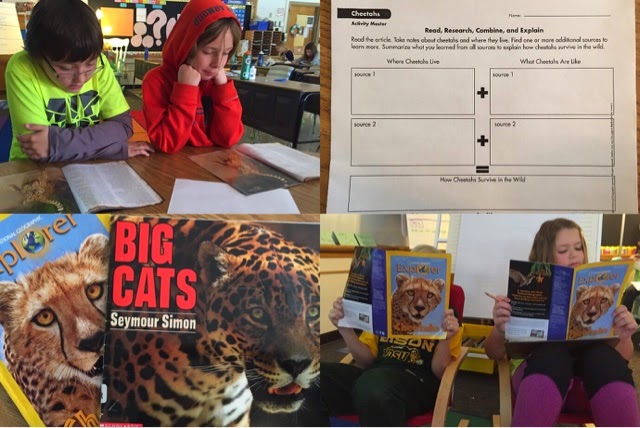
We dug into our current issue of National Geographic Explorer.  These magazines have become one of my very favorite resources for teaching informational (non-fiction) text. Our article focused on cheetahs and how these animals survive in the wild. Students were seriously impressed by some of the physical features of these animals. Our task was to read the article, then reread in search of information about where cheetahs live and what they are like in order to take notes, and then research further in our second source, Big Cats by Seymour Simon. Pulling from multiple sources helped us synthesize information to gain a more holistic perspective of these animals. This ability to read, understand, and synthesize information on a topic from multiple sources is a huge skill for students as they mature as readers and researchers.


SPELLING / GRAMMAR - Oh...just worked a little on how to add suffixes to words and some common spelling "rules." Also spent a good chunk of time on prepositions and prepositional phrases, but of course I forgot to snap a picture of that page. Oops!


Saturday, May 10, 2014

National Geographic Explorer

One our favorite texts to read has been the National Geographic Explorer Magazines that arrive each month. The articles are SO interesting and the pictures are fabulous. Here, Rylee adds more detail to our main idea/topic and supporting details organizer. This article from a recent issue talked about the possibility of a food shortage due to increasing population around the world, and then showed a few new ways to either grow or make food via a food printer. We all agreed that, while the idea is cool, the nutritional content and chemical additives would probably pale in comparison to a home cooked and home grown meal. Can't replace food with powder! Or so we think...